Smart Learning.
Every level of Ghana's education stack — from kindergarten to PhD — and the educators and students who animate it. Connectivity, devices, and platforms designed for how Ghanaian classrooms actually work.
Free SHS expanded access. Now we have to expand learning.
Ghana has roughly 800 public Senior High Schools serving over a million students, thousands of public Junior High Schools, twelve major public universities, and a growing TVET footprint. Free SHS dramatically widened access. What it did not do — what it could not do alone — was give every student a tablet, every classroom Wi-Fi, every teacher a laptop, or every school a reliable broadband connection.
Smart Learning closes that loop. One connectivity layer across every level of the education stack, with devices financed so families and the state can afford them, and platforms that make digital teaching the default rather than the exception.
An education sector ready for connectivity it doesn't yet have.
A complete learning-infrastructure stack.
Institutional connectivity
Managed broadband sized to enrolment, classroom Wi-Fi, content-filtered access, and resilient backup for every campus from KG to university.
Financed devices
Tablets for students, laptops for teachers and lecturers, financed over 36 months with parental, GETFund, or payroll underwriting.
Education platforms
Curriculum content cached locally, exam-prep tools, parent communication, attendance, and lesson-management systems integrated with the network.
Eight learning environments. One unified architecture.
Each sub-cluster is a complete deployment specification — different scale, different anchors, different payer logic, but the same underlying network and platform stack.

SMART KINDERGARTENS & PRIMARY SCHOOLS
Foundational connectivity, teacher tablets, and parent communication for the earliest years.

SMART JUNIOR HIGH SCHOOLS
Classroom connectivity, BECE-prep platforms, and student devices for the basic-school transition.

SMART SENIOR HIGH SCHOOLS
Full classroom Wi-Fi, WASSCE-prep platforms, and tablets-per-student programmes.

SMART UNIVERSITIES
Campus-wide managed networks, research bandwidth, and student broadband bundles.

SMART TECHNICAL & VOCATIONAL
Connectivity for NVTI, polytechnics, and COTVET institutions delivering hands-on skills.

SMART TEACHERS
Productivity bundles — laptop, curriculum tools, payroll-deducted financing — for Ghana's 70,000+ educators.

SMART STUDENTS
Device-and-data subscriptions for students from SHS through tertiary, financed and bundled.
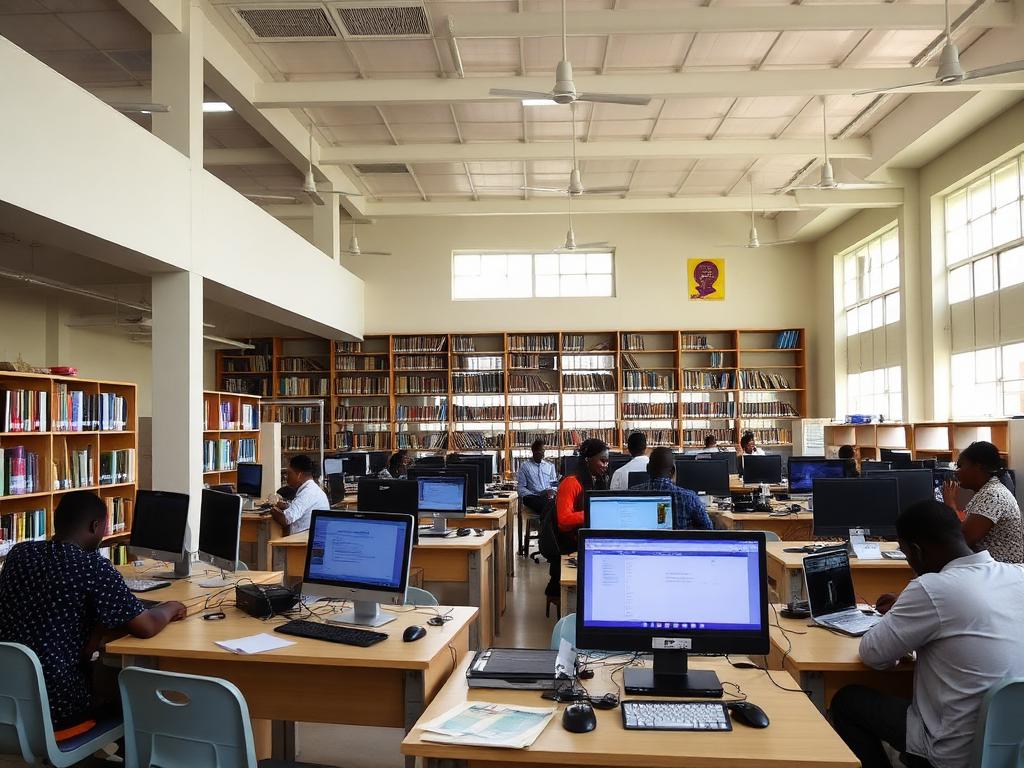
SMART LIBRARIES
Public library branches as community connectivity and learning hubs.
What Smart Learning looks like, lived.


Three payer logics, one segment.
Smart Learning revenues come from a mix of institutional contracts, parental and student subscriptions, and underwritten device-financing books. The mix de-risks the segment and creates clear blended-finance entry points.
What the segment looks like at maturity.
Indicative figures. Detailed addressable-market analysis and unit economics provided to qualified investors under NDA.
Who anchors Smart Learning.
- Ministry of Education
- Ghana Education Service (GES)
- National Council for Tertiary Education (NCTE)
- NaCCA (curriculum)
- Ghana Library Authority
- GETFund
- World Bank Global Partnership for Education
- Mastercard Foundation
- Jacobs Foundation
- KOICA
- Public universities (KNUST · UG · UCC · UENR · UMaT · UPSA · GIMPA · others)
- Public Senior High Schools and Junior High Schools
- TVET institutions (NVTI · polytechnics · COTVET-aligned)
What Smart Learning changes.


Smart Learning sits alongside…
Anchor, fund, or supply Smart Learning.
Whether you're a ministry, a foundation, a development partner, or a technology supplier — there's a place to plug in.